If you’re confused about yarn weights, don’t worry, you’re not alone! As you dive deeper into crochet and knitting, understanding the yarn weight system becomes important for your projects. Yarn weights can seem tricky, but this article will help clear things up.
UPDATED: AUGUST 2, 2024 BY BRITTANY
This post may contain affiliate links. See our Disclosure Policy for more information.
In the following sections, we’ll answer the most common questions about yarn weights and how they affect your projects. By the end, you’ll feel confident choosing the right yarn for any project.
Here’s a quick overview of the topics we will cover in this article:
- What Does Yarn Weight Mean?
- What Are Different Weights of Yarn?
- Yarn Weight Labels & Symbols
- What Do Yarn Weight Numbers Mean?
- How to Tell What Weight a Yarn Is
- Yarn Weight Conversion Chart
- Yarn Weights and Hook/Needle Size
- How to Substitute Yarns Based on Yarn Weights
- Are Some Yarn Weights Better for Certain Projects?
- Projects By Yarn Weights
- What Projects Are Best With Each Yarn Weight?
What Does Yarn Weight Mean?
Yarn weight describes how thick or thin a yarn strand is. It’s a way to categorize yarn based on its thickness. Knowing the yarn weight is important because it affects how your finished project looks and feels. Different yarn weights are better for different types of projects, so understanding them helps you choose the best yarn for what you’re making.
What Are Different Weights of Yarn?
You’ve probably seen yarn labeled with names like bulky weight, DK weight, Aran, or worsted weight. Ever wondered where these names come from or why there are so many terms for similar yarn weights? (Don’t worry, it’s not to confuse you!)
Yarns are categorized using a standard system of numbers, symbols, and names. This system was set up by The Craft Yarn Council, which includes major yarn companies like Bernat, Caron, Lion Brand, and others. This system helps keep things consistent, making it easier to follow patterns and know exactly what weight of yarn you’re using.


These symbols are part of the “standard yarn weight” system used by yarn companies in the Craft Yarn Council. Yarns from these companies all get a weight category, and the matching weight icon is printed on the label. This helps you easily find the right yarn for your project.
What do Yarn Weight Numbers Mean?
The Craft Yarn Council uses numbers to show how thick or thin yarn is, making it easy to choose yarn and follow patterns. The scale starts at 0 for the thinnest yarns and goes up to 7 for the thickest.
Think of the number on the label as a quick way to know the yarn’s weight. For example, if you see the number 4, it means you have a medium-weight yarn. Even if you switch brands, a number 4 still means medium weight.
How to Tell What Weight a Yarn Is
The easiest way to find out a yarn’s weight is by checking its label. If it’s from a Craft Yarn Council member brand, you’ll see a symbol on the label showing the weight. For yarns not from Craft Yarn Council brands, the label might use specific words to describe the weight.
If you come across a term you’re not sure about, it’s like using a Thesaurus to find similar words. Check this yarn weight chart to get a better idea of what the term means.
Yarn Weights Conversion Chart
| Craft Yarn Council | US Term | UK Term | AUS Term |
|---|---|---|---|
| (0) Lace | Lace | 1 ply | 2 ply |
| (1) Super Fine | Fingering/Sock | 2 ply | 3 ply |
| (2) Fine | Sport | 4 ply | 5 ply |
| (3) Light | Light | DK | 8 ply |
| (4) Medium | Worsted | Aran | 10 ply |
| (5) Bulky | Bulky | Chunky | 12 ply |
| (6) Super Bulky | Super Bulky | Super Chunky | 14 ply |
| (7) Jumbo | Jumbo |
To make things easier, the words in each row of the chart mean the same thing. You don’t need to remember them all right away, but over time, you’ll get used to them as you knit and crochet.
Which words should you use? It depends on where you live and where you buy your yarn. I’m in the United States, so I use Craft Yarn Council terms in my patterns and throughout this website. If you’re in the UK or Australia, you might be more familiar with the terms used there.
It’s best to use the terms from where you are. If you come across a term you don’t know, check this chart to convert to terms you’re more familiar with.
How to Tell The Yarn Weight Without a Label
If you remember the brand, try looking it up on the manufacturer’s website. They’ll always include the weight somewhere in the description.
If you don’t know the brand or where the yarn came from, you can compare it to another yarn with a label. This won’t give you a precise answer, but it’s a good starting point.
Be sure to make a gauge swatch before starting your project to make sure the sizing will be correct. If you’re new to gauge, check out my article about it—it’s an important topic you’ll want to understand!
Yarn Weights and Hook/Needle Size
Now that you know how yarn weights are categorized around the world, you might wonder if there’s a standard hook or needle size to use with each weight. There kind of is!
Yarns from Craft Yarn Council brands usually include a recommended hook or needle size on the label to help you get started. If you’re using yarn that doesn’t use Craft Yarn Council terms, you can use a chart to find the equivalent sizes.
| Weight | Hook Size | Needle Size |
|---|---|---|
| (0) Lace | 1.5-2.25 mm | US 1-3 |
| (1) Super Fine | 2.25-3.5 mm | US 2-4 |
| (2) Fine | 3.5-4.5 mm | US 2-5 |
| (3) Lightweight | 4.5-5.5 mm | US 5-7 |
| (4) Medium | 5.5-6.5 mm | US 7-9 |
| (5) Bulky | 6.5-9 mm | US 9-11 |
| (6) Super Bulky | 9+ mm | US 11-17 |
| (7) Jumbo | 15+ mm | US 17+ |
While this recommendation is helpful, it’s just a starting point. The hook or needle size on the label is meant to help you match the gauge shown.
Here’s an example. This is the label for a medium-weight yarn.
- With a 6 mm crochet hook, you should get 11 stitches and 14 rows in a 4-inch square.
- With a 5 mm knitting needle, you should get 16 stitches and 22 rows in a 4-inch square.
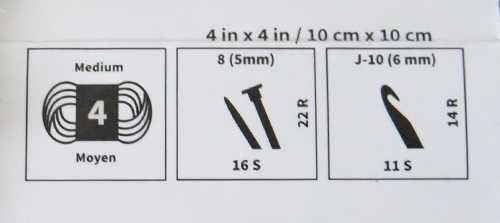
This information is a good reference, but if your pattern specifies a different size hook or needle, follow that.
The recommended size on the yarn label is a starting point, but the pattern designer might suggest a different size to ensure your project looks and feels just right. Using the recommended sizes on a yarn label will give you an average drape and gauge, but you can adjust if you prefer a stiffer or looser result.
How to Substitute Yarns Based on Yarn Weights
Even though I try to suggest yarns that are easy to find for my patterns, you might still have trouble finding them or might want to use yarn you already have.
In these cases, knowing how to choose the right substitute is important so you’re happy with the final result of your project.
Just because a yarn is in the same weight category doesn’t mean it will work as a substitute. You also need to consider the fiber content and make sure it’s the same thickness as the recommended yarn (since there can be some variation within the same weight category).
I’ve written an article with six easy steps to help you pick the perfect yarn substitute for your project.
Are Some Yarn Weights Better for Certain Projects?
If you’re following a pattern, you won’t need to worry too much about choosing the right yarn weight. But if you’re making something like a simple scarf or blanket on your own, it’s good to think about this.
Different yarn weights work better for different projects, and what works best can be pretty subjective. As you try out various yarn weights and complete different projects, you’ll find some weights work better for certain items than others.
For example, I usually avoid super bulky yarns for baby hats because they end up too bulky for such a small size.
Here are a few questions to ask yourself when choosing the right yarn weight:
- How big will the project be?
- How much time do you have to work on it?
- Does it need to be durable or flexible?
Thinner yarns take more time to work with because they require more stitches to complete a project. Thicker yarns are faster to finish because you use fewer stitches. If you’re working on a large project and have a tight deadline, a thicker yarn might be a better choice. However, if you have more time, a lighter yarn could be great for a smaller project, like a hat.
Also, think about the drape of your project. Drape is how the fabric flows and feels, and it depends on yarn weight, hook or needle size, gauge, and stitch pattern. For example, do you want your project to be soft and flowy, like a sweater, or stiff and sturdy, like a basket?
Generally, thinner yarns create lighter, more flexible fabrics, while thicker yarns make more durable, rigid fabrics.
What projects are best with each yarn weight?
You can use almost any yarn weight for any project, but some combinations work especially well together. Based on my experience, including how the fabric drapes and how long it takes to make, here are some suggestions. They’re not the only options, but they’re a good starting point if you’re unsure where to begin.
Projects By Yarn Weights
| (0) Lace | Shawls & Layering garments |
| (1) Super Fine | Doilies, Socks & Shawls |
| (2) Fine | Sweaters, Light Scarves, Baby Clothing |
| (3) Light | Baby Blankets, Sweaters & Scarves |
| (4) Medium | Hats, Scarves, Blankets & Bags |
| (5) Bulky | Blankets, Cowls & Home Decor |
| (6) Super Bulky | Blankets, Pillows & Rugs |
| (7) Jumbo | Rugs & Novelty Blankets |
When I was starting out, I found it helpful to keep a project journal. I made notes about my favorite yarns, hook sizes, and which projects they worked best for. This kind of journal can be a great reference for you as you experiment with different yarns and projects!