When you start exploring the world of designing crochet patterns, whether it’s for a hobby or a more serious endeavor, understanding how much yarn you’ve used is a fundamental skill to develop.
In this article, I’ll walk you through the steps to figure out how much yarn you have in your design and share some valuable tips I’ve picked up during my 10+ years of pattern designing.
UPDATED: FEBRUARY 13, 2026 BY BRITTANY
This post may contain affiliate links. See our Disclosure Policy for more information.
Standing in the yarn aisle wondering how many skeins to grab? I’ve been there! Here’s the quick version: Most adult hats need 200-300 yards, scarves need 375-600 yards, and baby blankets typically need 1,000-1,500 yards of medium weight yarn.
But here’s the thing – these are just ballpark estimates, and your actual yarn needs can vary quite a bit depending on your project size, stitch choice, and how tightly or loosely you crochet.
That’s exactly why I created this guide! Whether you’re:
- Planning your first big project and want to buy the right amount of yarn
- Designing your own patterns and need to calculate exact yardage
- Just curious about why some projects eat through yarn faster than others
…you’re in the right place.
What You’ll Learn: In this article, I’ll show you both the quick method (grab our handy chart and estimate) and the precise method (calculate exactly how much yarn you used) for figuring out yarn amounts. I’ll also teach you how to build your own automatic yarn calculator that does all the math for you – no spreadsheet skills required!
Ready to never buy too much (or too little!) yarn again? Jump straight to the yardage chart or keep reading to learn the full method.
- How Much Yarn Is Needed for Basic Projects?
- Why Different Yarn Weights Need Different Yardage
- How to Figure Out How Much Yarn Is In Your Project
- This is How to Use Weight to Figure Out How Much Yarn You Used
- Figure Out How Much Yarn Automatically
- How to Build a Simple Yarn Calculator
- Try It Now: Interactive Calculator
- 5 Yarn Calculation Mistakes That Will Mess Up Your Project (And How to Avoid Them)
- Frequently Asked Questions
How Much Yarn Is Needed for Basic Projects?
If you’d rather skip the calculations and want an easy way to estimate how much yarn you’ll need for typical projects, we’ve got you covered with this chart.
| Fine Weight Yarn (#2) | Light Weight Yarn (#3) | Medium Weight Yarn (#4) | Bulky Weight Yarn (#5) | Super Bulky Weight Yarn (#6) | |
| Adult Sized Sweater | 1750-2600 yds | 1500-2200 yds | 1100-1600 yds | 950-1100 yds | 800-1100 yds |
| Baby Blanket | 1250-1500 yds | 1125-1250 yds | 1000-1150 yds | 850-1000 yds | 750-900 yds |
| Hat | 250-300 yds | 200-250 yds | 200-225 yds | 120-200 yds | 125-175 yds |
| Scarf | 450-600 yds | 375-450 yds | 375-450 yds | 250-400 yds | 250-400 yds |
| Shawl | 450-700 yds | 400-600 yds | 375-550 yds | 350-500 yds | 350-500 yds |
| Socks | 300-450 yds | 275-400 yds | 250-350 yds | 250-350 yds | 200-250 yds |
| Throw Blanket | 3500-3750 yds | 3000-3500 yds | 2250-3150 yds | 2000-2300 yds | 1600-2000 yds |
Remember, these are just rough estimates. The real amount of yarn you’ll need for your project can vary based on factors like the stitch pattern, size, and the pattern’s gauge.
Why Different Yarn Weights Need Different Yardage
Ever wonder why the same beanie pattern uses 200 yards in worsted weight but 300 yards in fingering weight? It’s a question I get all the time, and the answer is actually pretty interesting!
Think of it this way: thicker yarn means bigger stitches, which means you need fewer stitches to cover the same area. It’s kind of like coloring with a thick marker versus a fine-tip pen – the marker fills the space much faster.
The Science Behind Yarn Weights
When you work with bulky yarn, each stitch is physically larger and covers more surface area. So to make that same adult-sized hat, you’re creating fewer total stitches, which means less yarn overall.
But here’s the catch – bulky yarn is heavier per yard, so even though you’re using fewer yards, you might still end up with similar skein counts! That’s why experienced crocheters focus on yardage, not just “how many skeins.”
A Real-World Example: The Same Scarf in Three Weights
Let me show you what I mean with an actual example. I’ve made the same basic scarf pattern (8 inches wide, 60 inches long) in three different yarn weights:
Fingering Weight (#2):
- Used approximately 525 yards
- Took 18 hours to complete
- Result: Lightweight, drapey scarf perfect for spring
Worsted Weight (#4):
- Used approximately 400 yards
- Took 8 hours to complete
- Result: Classic everyday scarf with nice drape
Bulky Weight (#5):
- Used approximately 275 yards
- Took 4 hours to complete
- Result: Cozy, chunky scarf that works up fast
See the pattern? As the yarn gets thicker, you need less yardage and less time to create the same physical dimensions. This is why bulky yarn projects are so popular with beginners – you get that instant gratification!
What This Means for Your Projects
When you’re planning a project, understanding this relationship helps you:
Make smarter substitutions – If a pattern calls for one yarn but you want to use another, don’t expect to need the exact same amount. Always make a gauge swatch to be sure!
Budget accurately – Don’t assume “one skein = one skein” across weights. A skein of fingering weight might have 400+ yards while a bulky skein might only have 130 yards.
Plan your time – Thicker yarn = faster project. If you need a gift in a hurry, reach for that bulky or super bulky yarn!
If you’re curious to dive deeper into how yarn weights work and what all those numbers mean, I’ve got a comprehensive guide to yarn weights that breaks it all down.
How to Figure Out How Much Yarn Is In Your Project
In order to figure out how much yarn you used in your project or design, you need to know three things:
- The weight of the skein of yarn you used.
- How many yards/meters of yarn is in the skein.
- The weight of the finished project.
With these three pieces of information, use the following steps to calculate exactly how much yarn is in the project. I’s pretty straightforward, and you can even make a spreadsheet to do all the work for you!
Step 1: Weigh the Project
The weight of your project is essential when figuring all this out, so having a reliable scale is a must. My top pick is a kitchen scale; it’s great for most projects, although for really big ones like blankets, it might not be the best choice because they often hang over the sides of the scale.
A couple of things to consider when choosing a scale:
- Units – Whether you use meters and grams or ounces and yards, make sure your scale can accommodate these units.
- Make sure it includes at least one decimal place.
- Bathroom scales generally won’t cut it.
The Accuteck All-in-1 Series scale has served me well for years. It has the right units, and the flip-out backing makes it easier to weigh bigger projects that are prone to hang off the back edge.
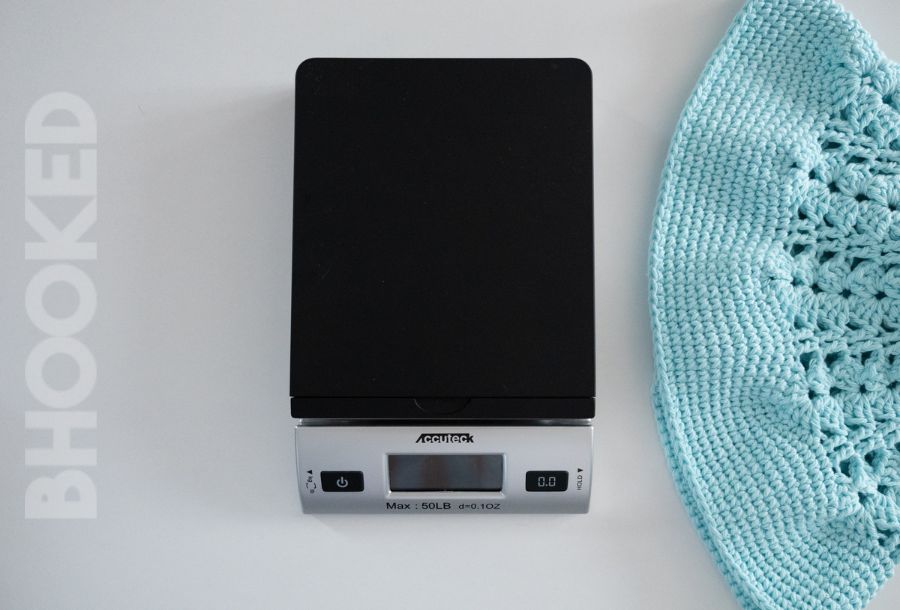
No matter which scale you choose, just make sure it has the following capabilities:
- Grams and ounces as a unit
- Capacity of at least 5 lbs
- Sensitivity of 0.1 oz
Once you’ve got a trustworthy scale, fold your project to make it fit, and then jot down the weight, rounding it to the nearest tens place.
Step 2: Record the Yarn Information
Once you’ve weighed your project, note down the weight of a single skein of yarn used in your project. You can find this info on the yarn label or weigh it using your scale. Just make sure you’re using the same units for the weight, so grams with grams or ounces with ounces.
Lastly, note down the total length of yarn in the skein. If you’ve used ounces, write down the length in yards; if you’ve used grams, note it in meters.
Step 3: How Much Does One Yard Weigh?
It might seem a bit tricky, but it’s not that bad, I promise. To figure out how much yarn is in your project, you just need to know the weight of a single yard (or meter) of that yarn.
To do the math, just divide the skein weight by the skein length. This will work out to be a really small number; a number way less than one.
Here’s an example:
Skein Weight = 3.5 oz
Skein Length = 207 yds
3.5 / 207 = 0.01690821256
Using this many units isn’t necessary. Using four decimal places is more than sufficient.
Step 4: How Much Yarn is in Your Project
One more simple calculation will tell you exactly how many yards are in your project. This time, just divide the weight of your project by the number you got in step 3.
So for our example:
Project Weight = 4.5 oz
4.5 / 0.0169 = 266.27 yards of yarn
This is How to Use Weight to Figure Out How Much Yarn You Used
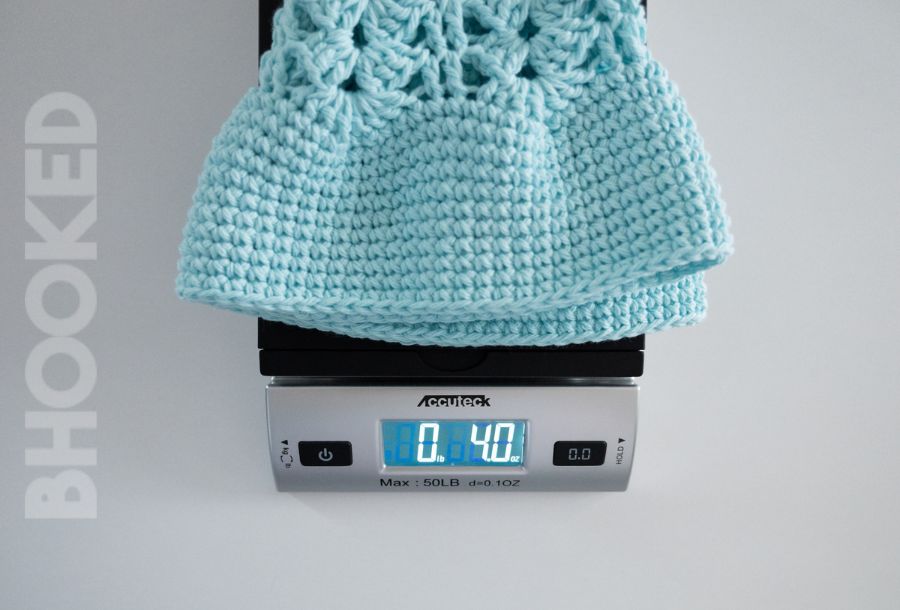
This is the simplest and easiest way to figure out how much yarn is in your project. It’s all about converting the project’s known weight into yards or meters using the known value of ounces to yards (or grams to meters) for the yarn you used.
Now, this method is handy when you want to figure out how much yarn you’ve used after finishing your project. Even if you’re not a designer and just like sharing patterns with friends or family, this quick calculation will be super useful.
As easy as this method is, there’s actually an even simpler way to do it. You can automate the whole process with just a few minutes of setting up a spreadsheet.
Figure Out How Much Yarn Automatically
To simplify your life, consider using a spreadsheet to handle these calculations for you automatically. While you can use a regular calculator, it’s a bit more manual. With a spreadsheet, all the heavy lifting is done for you. Just enter the yarn and project details, and presto! It gives you the project’s yardage.
These days, most folks have a Google account, and if you do, you can use Google Sheets, a completely free online spreadsheet tool. You don’t even need to download it. It’s accessible from any of your devices, which makes it super convenient. That’s why I prefer it, but if you already have access to Microsoft Excel, that’s another excellent option.
How to Build a Simple Yarn Calculator
No need to stress if you’re not a spreadsheet pro or if setting one up feels a bit intimidating. It’s actually way easier than you might imagine and won’t eat up too much of your time—just about 10 minutes or so.
I use Google Sheets because it’s free and I can access my yarn calculator on my computer and phone. If you prefer Microsoft Excel, you can use that too.
Open your spreadsheet and give it a name. Then, label the following columns (bolded text) :
| Yarn Type | Skein Weight (ounce or grams) | Skein Length (yards or meters) | (ounce/yards) or (grams/meters) | Project Weight | Yards/Meters in Project |
Decide which units you want to go with: either ounces and yards or grams and meters, and make sure to stick with your choice. Mixing up the units will mess up your calculations, so it’s important to keep it consistent.
With this setup, you’ll need to enter two calculations into your spreadsheet. In the (ounces/yards) or (grams/meters) column, enter the following equation:
Equation #1:
Click on the cell just below the oz/yd or g/m cell. Type the = key and click on the cell just below the skein weight. Next, type the / key and click the cell just below the skein length cell, and hit the enter key. You might see an error message that says #DIV/0! – don’t worry, it’s normal because there isn’t any project information added yet. This calculation will give you the ounces per yard of yarn (or grams per meter of yarn) and is used in the final calculation.
Equation #2:
Now, click on the cell just below the Yards/Meters in the project heading. Type the = key and click on the cell below the Project Weight heading. Type the / key and click the cell below the oz/yd or g/m heading (the one with the error from before). Then press enter, and you’ll see that same error again. But don’t worry, it’s perfectly normal.
To make that error vanish, the spreadsheet needs some data to do its thing.
So let’s give it a test run. Type “example project” in the cell below Project Name, “Lion Brand” in the cell below Yarn Brand, “alpaca blend” in the cell below Yarn Type, “3.5” for ounces or “100” for grams (depending on your chosen unit) in the cell below Skein Weight, “207” for yards or “190” for meters in the cell below Skein Length, and “4.5” for ounces or “128” for grams in the cell below the Project Weight heading.
Once you’ve plugged in this information, that error should vanish, and you’ll see actual numbers, with the most important one being the yardage (or meters) used in your project.
| Yarn | Skein Weight (ounce or grams) | Skein Length (yards or meters) | (ounce/yards) or (grams/meters) | Project Weight | Yards/Meters in Project |
| Patons Alpaca Blend | 3.5 ounces | 207 yards | 3.5 / 207 = 0.0169 | 4.5 ounces | 4.5 / 0.0169 = 266.27 yards |
Try It Now: Interactive Calculator
Don’t want to build your own spreadsheet? Use this interactive calculator right here! Just enter your yarn information and project weight, and it’ll do all the math for you instantly.
🧶 Yarn Calculator
Calculate exactly how much yarn you used in your project
Skein Information
Your Project
Your Results
5 Yarn Calculation Mistakes That Will Mess Up Your Project (And How to Avoid Them)
After more than ten years of designing patterns and teaching thousands of makers, I've seen these same yarn estimation mistakes pop up over and over again. The good news? They're all totally fixable once you know what to watch for!
Mistake #1: Not Accounting for Gauge Differences

This is the big one, and honestly, it trips up even experienced crocheters. Two people can follow the exact same pattern with the exact same yarn and use wildly different amounts of yarn – sometimes 20-30% more or less!
Why it happens: If you crochet tighter than the pattern designer, you're creating smaller, denser stitches. That means you need more stitches to reach the same dimensions, which means more yarn. The opposite is true if you crochet loosely.
How to avoid it: Always, always make a gauge swatch before starting a big project. I know it feels tedious, but it'll save you from running out of yarn three rows from finishing your blanket (been there, learned that lesson!). Check out my gauge guide if you need help with this.
Rule of thumb: If you're a tight crocheter, add 10-15% to the pattern's yardage estimate. If you're loose, you might need 10-15% less.
Mistake #2: Forgetting About Borders, Edging, and Finishing Touches
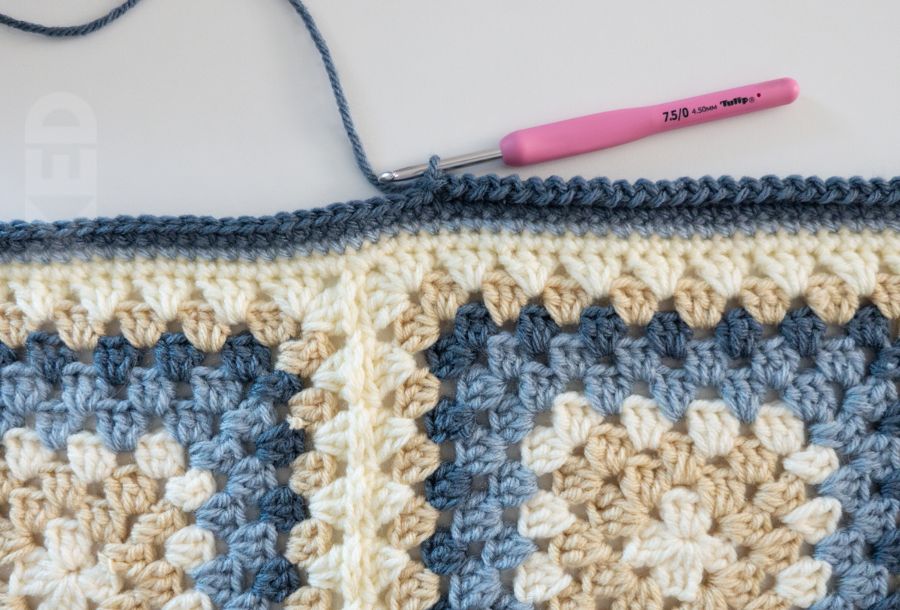
Oh, this one gets me every single time! You calculate perfectly for the body of your project, but then you add a beautiful scalloped border or some fancy edging and – whoops – you're short half a skein.
Why it happens: We tend to focus on the main part of the project and treat borders as an afterthought. But depending on the edging, you could need anywhere from 50 yards to several hundred extra yards.
How to avoid it:
- For simple single crochet borders, add 10-15% extra yarn
- For decorative borders (shells, picots, scallops), add 20-30% extra
- For wide borders or multiple rounds of edging, add 25-40% extra
- Always round up when buying yarn – it's better to have leftovers than to come up short!
Pro tip: If you're designing your own project, work the border last and calculate it separately. Weigh just the border and use our calculation method to see exactly how much it added.
Mistake #3: Not Buying Extra for Swatching
Here's a scenario I hear constantly: "I bought exactly 1,200 yards for this blanket pattern, but I used 150 yards making my gauge swatch, and now I don't have enough!"
Why it happens: Patterns tell you how much yarn the finished project needs, but they don't include the yarn you'll use (and usually won't unravel) for gauge swatches, practice squares, or mistakes.
How to avoid it: Always buy one extra skein beyond what the pattern calls for. Think of it as your insurance policy. You can always use leftover yarn for:
- Gauge swatches (which you shouldn't skip!)
- Fixing mistakes without frogging the whole thing
- Making matching accessories later
- Testing out new stitch patterns
- Your ever-growing scrap yarn collection
My personal rule: For any project requiring 3+ skeins, I buy one extra. It's saved me countless trips back to the yarn store (or the heartbreak of a discontinued dye lot).
Mistake #4: Assuming All Skeins of the Same Weight Have the Same Yardage
Just because two yarns are both "worsted weight" doesn't mean they have the same yardage per skein. This catches a lot of people when they're substituting yarn!
Why it happens: Yarn companies package their yarn differently. Some worsted weight skeins have 220 yards, others have 170 yards, and some have 364 yards. The weight category tells you the thickness, not how much is in the ball.
How to avoid it:
- Always check the yardage on the label, not just the weight category
- When substituting yarn, calculate based on total yardage needed
- Example: Pattern needs 600 yards of worsted. If your chosen yarn has 170 yards per skein, you need 4 skeins (680 yards), not 3 (only 510 yards!)
Quick math: Divide the total yards needed by the yards per skein, then round UP. Always round up!
Mistake #5: Not Considering Your Stitch Pattern

Here's something that surprises people: different stitch patterns eat through yarn at different rates, even with the same hook and yarn weight. A granny square blanket will use significantly less yarn than a cabled blanket of the same size.
Why it happens: Some stitches are yarn-hungry! Cables, popcorns, bobbles, and post stitches all use more yarn than basic single or double crochet. Lacy, open patterns use less yarn than dense fabrics.
The yarn usage spectrum (from least to most):
- Mesh/lace patterns: Least yarn
- Single crochet: Light usage
- Half double crochet: Moderate usage
- Double crochet: Moderate-high usage
- Treble crochet: Higher usage
- Cables, bobbles, popcorns: Most yarn
How to avoid it:
- If substituting stitch patterns, make a swatch in both stitches and weigh them
- For dense textured stitches, add 15-25% more yarn than a basic stitch pattern
- For lacy open work, you might need 10-20% less
Real example: I once made two baby blankets the same size – one in simple double crochet, one with a cable pattern. The cabled version used 230 yards more! That's almost two extra skeins of the yarn I was using.

From the podcast...
Need this concept to sink in a little more? Check out this episode of the BHooked Podcast where I go into even more detail about how to figure out how much yarn is in your project
Hit the play button below to listen!